Just noticed (i.e. read in the online help), that you can select the search-engine within the search-bar in Firefox with Ctrl-Up and Ctrl-Down, (when the search-bar is focused) i.e. you walk through the various search-engines.
Cool.
Btw: updated the falter.at search plugin to support side-bar results - ready to test here.
Tuesday, September 12, 2006
Sunday, September 10, 2006
Saturday, September 09, 2006
My first Firefox search plugin
Just created my first Firefox search plugin for searching the best restaurant guide for Vienna: "Wien, wie es isst" at falter.at.
You can find the plugin at the mycroft page.
You can find the plugin at the mycroft page.


Wednesday, September 06, 2006
NetBeans and JBoss
The JBoss Application Server and NetBeans IDE have been bundled together to provide NetBeans IDE users with a well integrated out of the box experience to build Java EE 5 applications on the JBoss Application Server.
Blogs as a mirror to society
I just noticed how blogs (or their statistics, rather) mirror our society:
Check out todays top searches on technorati:
#1 Steve Irwin , the crocodile hunter, who so tragically died being pierced by a stingray.
Check out the blogging statistics for his name (and note that the guy was of quite some fame when he was still alive):
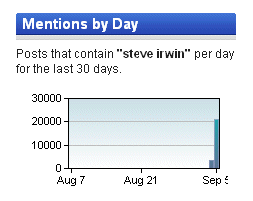
Nothing until Sep 4 (the day he died) and then 20.000+ postings a day !!!
Check out todays top searches on technorati:
#1 Steve Irwin , the crocodile hunter, who so tragically died being pierced by a stingray.
Check out the blogging statistics for his name (and note that the guy was of quite some fame when he was still alive):
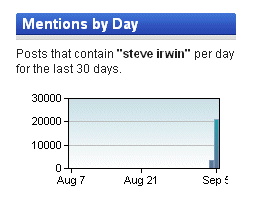
Nothing until Sep 4 (the day he died) and then 20.000+ postings a day !!!
Monday, September 04, 2006
Scoble?
Just noticed that since Scoble left Microsoft, I subscribed to his new feed, but I never read it...
So it really was more about Microsoft internals, than about Scoble.
So it really was more about Microsoft internals, than about Scoble.
Tuesday, August 29, 2006
Excellent service
 The power adapter of my thinkpad gave up on me the other day; so I called IBM/lenovo support, because the thing is still under warranty; they just had a replacement part sent to me next morning... no walk-in, no hassle, nothing; just a 5min phone conversation, where the guy checked my serial number against their warranty database, double checked my problem, and told me that it would be sent and should be there (i.e. at my home) next morning.
And it really was.
Great... execllent service (hate to say this about competition, but it nevertheless feels good).
Monday, August 28, 2006
BlogTalk in Vienna, Oct 2-3,2006
BlogTalk Reloaded - the conference is scheduled for Oct 2–3, 2006.It will be held in Vienna, Austria.
Sunday, August 27, 2006
Writely
 Finally Writely (recently bought by google) opened up for registration again a couple of days ago. So now I got my writely account and tried a view documents (all .swx or .odt). And those were quite complex.
Apart from a 500KB limit (boy, that's really low) it worked perfectly.
Even found some hidden/invisible anchors etc that I did not see in StarOffice.
It also comes with an RSS feed on the document revisions... great for people collaboratively working on documents.
Now if only they would enable to directly same from google mail... that would be something.
technorati tags: google, writely, staroffice, openoffice, odt
Wednesday, August 16, 2006
Kim Cameron on federation vs user-centric
Theres a very interesting series of comments on Kim Cameron's identityblog on the difference between user-centric identities (infocard) and federation (liberty) - and/or whether there is a difference at all.
Find the details at Kim Cameron’s Identity Weblog » Federation and user-centricity
technorati tags:identity, liberty, federation
Sunday, August 13, 2006
Caches, parte deux
Well, I guess I know the reason for the Google Desktop caching issue:
The website sends the following headers (and only those)
Wow, thats bad, ... really bad...
The website sends the following headers (and only those)
 HTTP/1.0 200 O
 Date: Sun, 13 Aug 2006 17:51:07 GMT
 Server: Apache
 Content-Type: text/html
Wow, thats bad, ... really bad...
Roman vs Caches
I'm struggling with caches now;
- Flock doesn't seem to pick up feed-changes (which with other readers work) - even if I force it to reload
- Google Desktop seems to cache XmlHttpRequest results, without me being able to control it (setting headers like pragma, cache-control, etc)
Saturday, August 12, 2006
Web Stuff I don't get...
e.g. MySpace or Digg ...
I can't even say what I dislike about them, I just don't get the hype around them... Take digg: it's nice, but why vote on articles? The "wisdom of crowds" quality it seems to get by it, is - IMHO - spoiled or rather lost, because it's always the same little crowdette that votes anyway - oligarchy rather then democracy...
I can't even say what I dislike about them, I just don't get the hype around them... Take digg: it's nice, but why vote on articles? The "wisdom of crowds" quality it seems to get by it, is - IMHO - spoiled or rather lost, because it's always the same little crowdette that votes anyway - oligarchy rather then democracy...
Google Desktop Gadget - revisited
Adding timer-support was a lot easier than doing the HTML parsing (see My First Google Desktop Gadget ).
Just init with
And in
Same goes for menus; add a refresh menu item like this
Easy, isn't it ?
Just init with
setInterval(OnTimer, 1000 * 3600 ); // check once every hourAnd in
function OnTimer() you we just call what we created before.Same goes for menus; add a refresh menu item like this
plugin.onAddCustomMenuItems = AddCustomMenuItems

function AddCustomMenuItems(menu)
{
  menu.AddItem(strMenuRefresh, 0, OnMenuRefresh);
}
function OnMenuRefresh(item_text)
{
  OnTimer()
}
Easy, isn't it ?
technorati tags:google, javascript,
My First Google Desktop Gadget
Tried out my first Google Desktop Gadget - purely, entirely in JavaScript.
It goes out to my provider's service homepage, retrieves the current DSL usage (for this month), does a lot of ugly HTML fixing/patching (boy, is their HTML broken), to finally pass into DOM.
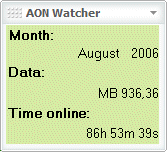
Then pick the relevant values out of the DOM and display them...
Took me about half a day; the most part was fixing the HTML, so not GD related.
Now comes the GD stuff, like how do I refresh every x minutes or so... stay tuned, tomorrow is another day.
It goes out to my provider's service homepage, retrieves the current DSL usage (for this month), does a lot of ugly HTML fixing/patching (boy, is their HTML broken), to finally pass into DOM.
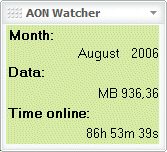
Then pick the relevant values out of the DOM and display them...
Took me about half a day; the most part was fixing the HTML, so not GD related.
Now comes the GD stuff, like how do I refresh every x minutes or so... stay tuned, tomorrow is another day.
technorati tags:google, javascript, dom
Friday, August 11, 2006
Varargs Puzzler
When I take a look at Richard Bair's Blog: Varargs Puzzler I feel that I have to learn a lot more about varags in Java 5 - actually I avoided them so far. I guess now I also know why ;-) They don't really seem to behave straightforward, to they.
technorati tags:java
Flock and technorati
Hm, flock offers a notification service for blogs, and also comes pre-configured with technorati (which is good), but it does not seem to ping technorati, when I post to my blog (through the flock interface)...
technorati tags:flock, feed, technorati, blog
Thursday, August 10, 2006
oops - Bugzilla vs RSS
This is sooo embarrassing: Bugzilla - contrary to my belief (IT conservations: Bugzilla vs RSS) of course does give you feed, at least on queries/searches. Still not on individual bugs, though.
Flock again
The cool thing about flock is, that it derives from firefox, so my (in the meantime) most important FF extension, ProxyButton, works here, too.
Wednesday, August 09, 2006
IE7... so ??
Microsoft is advertising on their site for IE7 with the slogan
we heard you. you wanted it easier and more secure.
Wow... what an insight. Couldn't they have guessed that - like years earlier.
And by the way: are they now admitting that IE4-6 were crap?
technorati tags:browser
Flock - posting to blogger
Had a little trouble with the recent post, because Flock (0.7.4.1) has a problem with the initial (!) blog setup.
First of all, setting up your blog(s) in Flock is easy: Just key in your blog url (e.g. it-conservations.blogspot.com and the provide userid/password; the rest will be done automagically.
However, to successfully post to my blog, I had to delete this setting and create the very same again with the following parameters (for blogger)
- blog-url
- userid/password
- get your blog id (can be found on your dashboard, or just view-source on your blog)
- api uri: https://www.blogger.com/atom/<blogid>
- api: atom (doesn't work with the blogger api also provided, at least not for me)
works like a charm then.
Flock
Started to test the new Mozilla/Firefox derivate: Flock

A neat little webbrowser (based on FF) that specialized on ... (dare I use the term) ... Web 2.0 features, i.e.
- integrated photo support (in my case flickr)
- integrated blog support (used for this post here)
- integrated rss support
Monday, August 07, 2006
Portlet 2.0 Spec early draft
Found on The Portal Post : Weblog
An early draft of the upcoming Portlet 2.0 Spec aka JSR286 is available.
An early draft of the upcoming Portlet 2.0 Spec aka JSR286 is available.

Sunday, July 30, 2006
We need more RSS!
Why don't people use more RSS? - or Atom for that matter;
Within my companies reporting system I can choose to have several reports (related to my job, obviously) sent to my e.g. daily via e-mail. So first of all, this is nice: I don't have to go into some BI-whatnot-datawarehouse-thing-application and query the data myself - quite convenient.
But it would be even greater if I could just (RSS-style-)subscribe to that data, and thus get a notification as soon as the data changes, and even better: I could more easiy integrate into my productivity applications (OpenOffice).
So people stop treating RSS as just a means to get blogs or news distributed; it's basically just about any kind of content.
personal note: I guess I have to include a default disclaimer in my template stating that I usually use RSS as a synonym for all the relevant protocols and their variations; but since I guess everyone but the religious guys does that it wouldn't make much difference.One such nice application for RSS is (enterprise internal) Business Intelligence:
Within my companies reporting system I can choose to have several reports (related to my job, obviously) sent to my e.g. daily via e-mail. So first of all, this is nice: I don't have to go into some BI-whatnot-datawarehouse-thing-application and query the data myself - quite convenient.
But it would be even greater if I could just (RSS-style-)subscribe to that data, and thus get a notification as soon as the data changes, and even better: I could more easiy integrate into my productivity applications (OpenOffice).
So people stop treating RSS as just a means to get blogs or news distributed; it's basically just about any kind of content.
Saturday, July 29, 2006
Whats up with technorati?
Was it the redesign? Is it just me?
Technorati is incredible slow - at least today.
And it also reports wrong content - it lists outbound links on my blog(s) that simply are not there.
Technorati is incredible slow - at least today.
And it also reports wrong content - it lists outbound links on my blog(s) that simply are not there.
The NetBeans worldTour

Coming this fall - The NetBeans worldTour.
Unfortunately they don't stop in Austria, but at least in Prague (well obviously, since netbeans is being developed in Prague).
Tuesday, July 25, 2006
DRDA book

This is just because I was asked - again.
Yes, it is true, I did write a book on DRDA once - The DB2 Universal DRDA Certification Guide, part of the IBM DB2 Certification Guides series.
So if you ever have to configure a DB2 connection from Windows to MVS (as if that was still around), I'm your man.
Monday, July 24, 2006
Saturday, July 01, 2006
gapingvoid
IT convservations now featuring the gapingvoid widget to directly include the daily gapingvoid cartoon.
Tuesday, June 27, 2006
Ethan Nicholas's Blog: All about intern()
A nice input on intern()ing Strings in Java.
Ethan Nicholas's Blog: All about intern().
Make sure to read the comments section regarding caveats in respect to gc.
Ethan Nicholas's Blog: All about intern().
Make sure to read the comments section regarding caveats in respect to gc.
Thursday, June 22, 2006
People finally getting RSS
... and with RSS I mean the mechanism, not the specific protocol or version (so this stands for RSS 0.x, 2.x and Atom as well).
Apart from RSS as a feed mechanism for news and blog sites, there are some nice RSS "applications" that provide a feed into a "personalized query" (for lack of other words).
 Take flickr for example: they provide (among others) an RSS feed for "Comments you made" (see my comments here.
 Or openBC: there you have a feed for e.g. "Members who have recently visited my contact page" or "Contacts of mine whose company or position has recently changed".
Very useful.
Apart from RSS as a feed mechanism for news and blog sites, there are some nice RSS "applications" that provide a feed into a "personalized query" (for lack of other words).
Take flickr for example: they provide (among others) an RSS feed for "Comments you made" (see my comments here.Or openBC: there you have a feed for e.g. "Members who have recently visited my contact page" or "Contacts of mine whose company or position has recently changed".Very useful.
Wednesday, June 21, 2006
Tuesday, June 20, 2006
Get a Mac - TV Ads
 There's a gazillion of reasons to buy a Mac (at least now), but the current TV ads are the best...
watch them here.
Apple - Get a Mac - Watch The TV Ads
And then buy one - I will.
Saturday, June 17, 2006
jMaki - AJAX for JSP

Just announced/released on ajax.dev.java.net with a nice democast.
Finally a neat JSP AJAX integration.
Seems like there finally is a reason to switch to JavaEE5 and Netbeans5.5.
Friday, June 16, 2006
EJB 3.0 sessions in 2006 JavaOne
Wonseok Kim lists the JavaOne sessions from this years JavaOne in his post.
Here (PDF) is a great intro/motivation presentation he points to.
Here (PDF) is a great intro/motivation presentation he points to.
Thursday, June 15, 2006
Monday, June 12, 2006
Nicholas Negroponte
In his Pop!Tech 2005 speech Nicholas Negroponte says:
Listen to it on the conversations network.
People who write software get basically remunerated for writing more software and what they are doing is writing more features.
If you just paid people for every line of code they removed instead of add you would have a much better software world.
Listen to it on the conversations network.
Friday, June 09, 2006
Google spreadsheets
Finally logged into Google spreadsheets yesterday... Why don't they support the OpenDocument format resp. OOo format?
Do we really need just another Excel?
Do we really need just another Excel?
Cool Mozilla hacks
A friend just pointed out the marvelous combination of Conquery and the mycroft.
The perfect example (quite local to him and me):
define the vienna city map search in mycroft and then mark an adress and go for it.
Cool.
mesh-up-y.
The perfect example (quite local to him and me):
define the vienna city map search in mycroft and then mark an adress and go for it.
Cool.
mesh-up-y.
Wednesday, June 07, 2006

Tuesday, June 06, 2006
Search engine optimisation ??
I just received an invitation to a search engine optimisation conference.
Hey, I thought we were already in 2006 ... who is still interested in
this ???
Google spreadsheets
 one more step in Google's way to the (web) office space: Google Spreadsheets - after they acquired Writely a couple of weeks ago for web-based text processing.
Sunday, June 04, 2006
Some JavaScript enlightenment
Dean Edwards posted the "Levels of JavaScript Knowledge".
Working comfortable on level 5, I have to admit, I didn't even know there was something like level 6...
Working comfortable on level 5, I have to admit, I didn't even know there was something like level 6...
Flickr
Flickr is usually traded as one of the signposts towards Web 2.0. And there's nothing to disagree with, since Web 2.0 is defined through examples like Flickr and GMail and Google Maps and so on.
Having played around with flickr for some time now, I have to admit its one of the best applications (or probably better: services) on the Web.
So, yes, flickr is pretty cool; if the web is really heading that way, I'll be glad to follow.
Having played around with flickr for some time now, I have to admit its one of the best applications (or probably better: services) on the Web.
- It serves a clear purpose, and (more important) does this perfectly
- it is driven by its users resp. the community (uploading, comments, tagging, groups, ...)
- it interoperates with various other services (e.g. blogging interface to all major blogging sites/types)
- it offers its own services to other services
- its user interface is just perfect, and I'm not (only) talking about its dynamic AJAX style, but also the way they guide a user and how you do configure your settings; they don't confront the user with tech terms, but mainly ask questions.

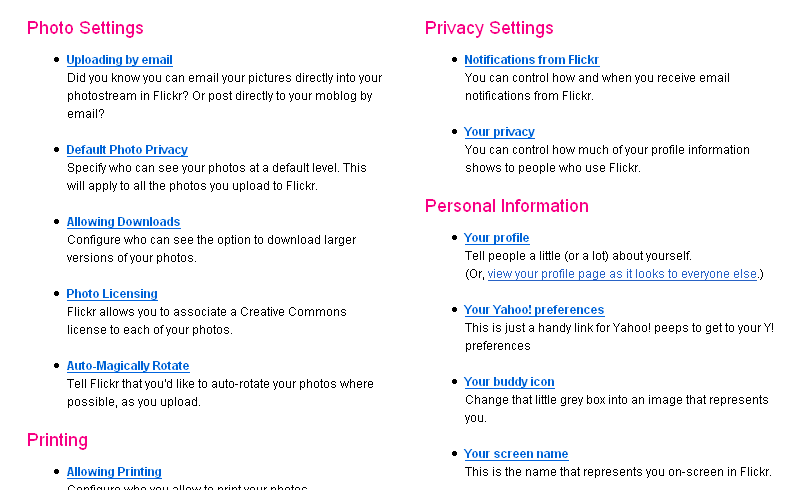
So, yes, flickr is pretty cool; if the web is really heading that way, I'll be glad to follow.
Thursday, June 01, 2006
Less is more - heresy ???
Listen to this interesting speech by Jason Fried at the Web 2.0 conference 2005.
Less is more ... heresy or true ?
I don't know, but I like the way he thinks...
Less is more ... heresy or true ?
I don't know, but I like the way he thinks...
Tuesday, May 30, 2006
AJAX, JSF and Creator
 I played around with Sun's Java Studio Creator2 today and its AJAX autocompletion component.
Very simple way to create a (web) textfield that has an autocompletion feature based on a server dictionary.
Really neat.
Linux on Sparc T1
Just learned that Ubuntu is running on Sun's Sparc T1 ("Niagara") cpu/boxes.
(Old news, granted, but new to me)
(Old news, granted, but new to me)
Monday, May 29, 2006
Sunday, May 21, 2006
Welcome to flickr
 Finally started to use my flickr account; will slowly upload some pic's there, so watch this space if you're interested.

Saturday, May 20, 2006
Skype sound test
 Just found out that Skype offers a sound check service.
Just call echo123 on Skype; you can leave a 10sec message there that is then played back to you...
Nice gimmick to check your end of the skype "line"...
Friday, May 19, 2006
OpenSource Java ??
Seems like it will finally take place.
However, I still believe that this might actually by a disservice to the Java idea of "run everywhere".
Remember what happened on the desktop (J2SE) when Microsoft had their own "enhancements" to the VM?
I'm afraid this might happen again.
IBM, though, will probably love it...
However, I still believe that this might actually by a disservice to the Java idea of "run everywhere".
Remember what happened on the desktop (J2SE) when Microsoft had their own "enhancements" to the VM?
I'm afraid this might happen again.
IBM, though, will probably love it...
Tuesday, May 16, 2006
Technorati
 I finally registered (myself and my blogs) on technorati.
Pretty cool stuff.
Whats best about it is, that with just one click you can see that actually no-one is interested in your blogs (if links represent interest, but thats the current thinking - and I agree with it).
Monday, May 15, 2006

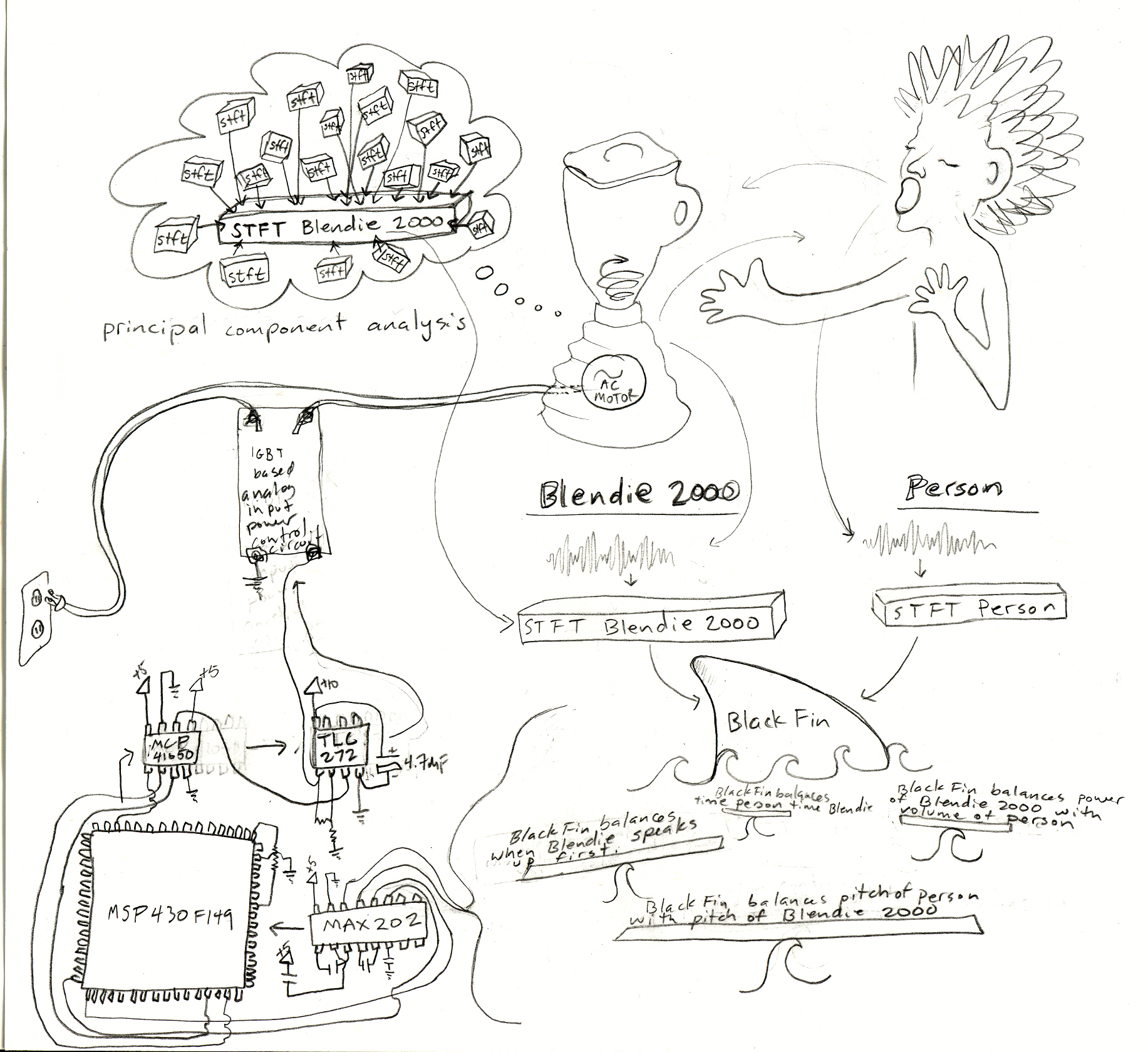
cool: voice controlled blender
there's no limit to innovation: the voice controlled blender by Kelly Dobson - description here, also comes with a blueprint and a demo video here
Java AppServer market share
Here's interesting statistics about current appserver market share.
Cool part is, that Sun through initiatives like Glassfish (the open source AS v9) and the Java Enterprise System (aka JES)licensing modell is now at 20% - not bad.
Cool part is, that Sun through initiatives like Glassfish (the open source AS v9) and the Java Enterprise System (aka JES)licensing modell is now at 20% - not bad.
- 37.2% - IBM Web Sphere
- 37.0% - JBoss Application Server
- 27.2% - BEA WebLogic
- 27.2% - Oracle 8iAS, 9iAS, 10gAS
- 19.7% - Sun Java Enterprise System
Thursday, May 11, 2006
Monday, May 08, 2006

Saturday, May 06, 2006
video: The Art of Demotivation
Slightly off-topic, but don't we all know companies and people like this:
The Art Of Demotivation
The Art Of Demotivation
Friday, May 05, 2006
book: The Wisdom of Crowds

Want to understand how wise crowds or groups (or communities for that matter) actually are - if only you let them ... read this fantastic book here:
The Wisdom of Crowds by James Surowiecki.
Sunday, April 30, 2006
JAR and classpath
Arghhhhh, this just cost me about 2hrs...
When running a Java application packaged into my own JAR from the command line with
java -classpath /somepath/library.jar -jar myJar.jar
it just wouln't pick up the library.jar.
You can specify a Class-Path entry in the manifest for your own jar, but thats only used to references jars within your jar, not really external jars.
No matter what I did, I would always get a java.lang.NoClassDefFoundError.
Here's the entry in Sun's Java Forum that finally solved it for me - I quote from the post:
Would it hurt to properly document this ??
When running a Java application packaged into my own JAR from the command line with
java -classpath /somepath/library.jar -jar myJar.jar
it just wouln't pick up the library.jar.
You can specify a Class-Path entry in the manifest for your own jar, but thats only used to references jars within your jar, not really external jars.
No matter what I did, I would always get a java.lang.NoClassDefFoundError.
Here's the entry in Sun's Java Forum that finally solved it for me - I quote from the post:
When the -jar option is used, the -classpath or any system classpath is ignored - the only classpath is the one in the manifest of the executable jar file, if specified.
Would it hurt to properly document this ??
Friday, April 28, 2006
OOo filters
New challenge: writing an OpenOffice/StarOffice import filter.
Makes the Thunderbird/XUL tasks a no-brainer.
Makes the Thunderbird/XUL tasks a no-brainer.

Thursday, April 27, 2006
SOA and "Business alignment"
Each and every presentation or textbook on SOA (including mine - presentation, not text book; not yet) starts with how IT has to align with "the business", etc, etc, ... and how there are application silos that seem to be the only thing that keep the business from being an "agile" one.
And everyone just assumes or implies that it is or was the IT department's fault that there currently is a misalignment (given there is one at all).
But weren't the business units those who requested those very silos. Or sometimes even demanded them.
(True, IT departments and the industry at large have their share as well).
But when it comes to SOA we simply assume that the cultural aspects of SOA is something IT has to learn. "The business" (i.e. the sum of the business units, quite a heterogeneous bunch themselves) has to become ready as well. They have to stop demanding their best-of-breed silos.
Once we get over that hurdle, SOA will be easy.
Well, don't quote me on the last one.
And everyone just assumes or implies that it is or was the IT department's fault that there currently is a misalignment (given there is one at all).
But weren't the business units those who requested those very silos. Or sometimes even demanded them.
(True, IT departments and the industry at large have their share as well).
But when it comes to SOA we simply assume that the cultural aspects of SOA is something IT has to learn. "The business" (i.e. the sum of the business units, quite a heterogeneous bunch themselves) has to become ready as well. They have to stop demanding their best-of-breed silos.
Once we get over that hurdle, SOA will be easy.
Well, don't quote me on the last one.
Monday, April 10, 2006
Redhat buys JBoss
So finally Redhat bought JBoss...
now it's getting interesting in the J2EE appserver market again.
now it's getting interesting in the J2EE appserver market again.
Saturday, April 08, 2006
Java for-each vs iterator
Being really happy that in Java 5 the for-each shorthand for loops over collections and the like was introduced, I ran into a stupid pitfall the other day.
With an iterator you can remove an element from the underlying collection using the iterator.remove() method, like this
This is no longer visible if you change from iterator to for-each:
Since the iterator is not exposed to your code, the pitfall is to remove the object directly from the collection...
This will cause a ConcurrentModificationException... not a nice thing to do. But actually its quite clear and obvious.
Afterwards...
With an iterator you can remove an element from the underlying collection using the iterator.remove() method, like this
Iteratorit = somelist.iterator();
while (it.hasNext())
{
MyObject o = it.next();
// o.dosomething();
it.remove(); // removes the current object from the list
}
This is no longer visible if you change from iterator to for-each:
for (MyObject o : somelist)
{
// o.dosomething();
somelist.remove(o); // removes o from the list
}
Since the iterator is not exposed to your code, the pitfall is to remove the object directly from the collection...
This will cause a ConcurrentModificationException... not a nice thing to do. But actually its quite clear and obvious.
Afterwards...
Friday, April 07, 2006
why bootcamp
why use bootcamp to dual boot a intel mac (which is soooo '80s), when there's parallels, which uses a hypervisor approach... so you should be able to fade in windows when you need it, instead of rebooting...
Wouldn't that be ... like ... um ... better ?
(or rather vmware, and move my PC image right over to the mac... well, I'm allowed to dream...)
Wouldn't that be ... like ... um ... better ?
(or rather vmware, and move my PC image right over to the mac... well, I'm allowed to dream...)
book: SOA with webservices
one of the most important books regarding SOA.
Eric Newcomer's Understanding Service-Oriented Architecture (SOA) with Web Services".

A must, when going into SOA...
Eric Newcomer's Understanding Service-Oriented Architecture (SOA) with Web Services".
A must, when going into SOA...
Tuesday, March 28, 2006
reading: Software Hardball
McNealy's comment in the WSJ, read it at sun.com as a pdf. http://www.sun.com/aboutsun/media/features/McNealy_Oped-WSJ_3-3-06.pdf
(or - if you like to pay for content thats otherwise free - purchase it at the WSJ here.)
(or - if you like to pay for content thats otherwise free - purchase it at the WSJ here.)
Monday, March 27, 2006
Thunderbird vs XUL
or should I rather say Thundberbird and XUL vs documentation:
Current score:
Thunderbird 5 : 0 documentation
Current score:
Thunderbird 5 : 0 documentation
Sunday, March 26, 2006
more java puzzlers
very interesting article/inverview with Joshua Bloch to go with the Java Puzzlers book.
Friday, March 24, 2006
Java Puzzlers

The ultimate java reading: Java Puzzlers by Joshua Bloch:
Top companion to Effective Java, by the same author.
Read it, learn it, live it.
Wednesday, March 22, 2006
iCal - finally
Ok, so I finally found a good Java iCal parser and got it working on most of the .ics files I have:
iCal4J at sourceforge
It does have problems with CHARSET properties, because it doesn't know them.
Which is actually in line with RFC2445... however, they do exist.
To work around this you have to write your own content handler, but it works.
iCal4J at sourceforge
It does have problems with CHARSET properties, because it doesn't know them.
Which is actually in line with RFC2445... however, they do exist.
To work around this you have to write your own content handler, but it works.
Tuesday, March 21, 2006
Calendars - again
So I've been complaining about timezones recently.
There is something worse: charsets.
(Yes, we knew that already).
More specifically, charsets within iCal "documents".
I'm not really sure whether anything above ascii 127 is actually allowed by RFC2445 or not.
The RFC doesn't seem to be too clear about it.
More importantly - and annoyingly - I just started working with an iCal parser that believes they are not.
So everything abvoe 127 terminates e.g. a description or summary.
German invitations/events tend to have äöüß in them (especially the ß in the location component), yet they don't parse correctly...
Sigh - again.
There is something worse: charsets.
(Yes, we knew that already).
More specifically, charsets within iCal "documents".
I'm not really sure whether anything above ascii 127 is actually allowed by RFC2445 or not.
The RFC doesn't seem to be too clear about it.
More importantly - and annoyingly - I just started working with an iCal parser that believes they are not.
So everything abvoe 127 terminates e.g. a description or summary.
German invitations/events tend to have äöüß in them (especially the ß in the location component), yet they don't parse correctly...
Sigh - again.
Monday, March 20, 2006
Calendars - sigh
There are many problems as the industry tried to establish a calendaring/scheduling standard.
Less technical.
Technially speaking everything seems to be solved (for me).
The problem is rather – I think – in the plethora of ways people (in real life) work with calendars, and how their understanding of scheduling is.
One of the problems is e.g. with the understanding of recurring events (not covered today). The other is with time zones, and how people ignore them.
Yes - time zones.
We thought, that the problems of specifying a local time were actually solved with the invention of time zones.
Still, what do you do (programmatically, not as a human being), when you receive an calendar event without any time zone information.
Not even a UTC marker (as in the generally accepted ISO8601 standard).
Which time zone does this event fall into?
In real life you say “The time zone of the organizer or the person you received the invitation from (i.e. the sender)”, and you are usually able to resolve this, because in real life you at least have a hint what their time zone might be.
As a program, how do you tell – in the absence of any TZ information?
Which TZ do you pick?
Is it fair to assume that then sender has the same TZ as you (the receiver) has?
Or should you just shoot programmers who do not include TZ information in their events?
Or is it the standard ? ISO8601 allows for empty TZ information and simply declares those as being "local". Local to what?
The voting is open ... :-)
Less technical.
Technially speaking everything seems to be solved (for me).
The problem is rather – I think – in the plethora of ways people (in real life) work with calendars, and how their understanding of scheduling is.
One of the problems is e.g. with the understanding of recurring events (not covered today). The other is with time zones, and how people ignore them.
Yes - time zones.
We thought, that the problems of specifying a local time were actually solved with the invention of time zones.
Still, what do you do (programmatically, not as a human being), when you receive an calendar event without any time zone information.
Not even a UTC marker (as in the generally accepted ISO8601 standard).
Which time zone does this event fall into?
In real life you say “The time zone of the organizer or the person you received the invitation from (i.e. the sender)”, and you are usually able to resolve this, because in real life you at least have a hint what their time zone might be.
As a program, how do you tell – in the absence of any TZ information?
Which TZ do you pick?
Is it fair to assume that then sender has the same TZ as you (the receiver) has?
Or should you just shoot programmers who do not include TZ information in their events?
Or is it the standard ? ISO8601 allows for empty TZ information and simply declares those as being "local". Local to what?
The voting is open ... :-)
Tuesday, March 14, 2006
online music, its price & DRM
Isn't the problem of music download rather in the old business model of the recording industry?
Their model was built on charging for the media, i.e. the carrier of the (copyright protected) song/music. If you bought the same song a second time (e.g. on a sampler LP, or you broke the record and had to buy it again), did they step up to you and said, “No wait, you already paid for that; we'll just take some cent for the vinyl this time”?
Well, they didn't come knocking on my door.
Quite the contrary, by changing from vinyl to CDs, they built an entire industry around charging a second time for the very same content.
Again: The whole business model was built around charging for the physical carrier.
But know, since they lost control over the distribution channel, it's suddenly all about the (protected) rights of the artist and their royalties. (... and they do have a right to receive royalties).
In Austria and Germany (and probably some other countries as well), there was (and still is) a surcharge on each and every blank (!) MC, CD, DVD, ... just because you might copy something on it, that is royalty afflicted. Doesn't that actually imply that I can freely download (or copy) from whatever source, because I already paid some royalty? Or can I then get a refund for the surcharge on the blank CD...
Was there any limitation on a vinyl that kept me from playing “my” (in a DRM sense) record on my friends record player? No.
The only limitation was that I didn't give away my records, I couldn't “share” them. I could only lend them to a friend, and I wanted to get them back – preferably without a scratch.
And, because everything was analog, a copy had less quality than the original.
And this model of sharing formed the base for the average price of a song or LP.
Meaning: the recording industry and the artists knew that some people gave away their LPs, and their friends copied them to MCs... This limited sharing/copying was already calculated into the price of every LP/CD/...
Divide the price of a LP/CD - about 15 US$ for a new release - by the number of tracks it features, say 12.
What do you get (apart from 1.25$) ? The price per track/song.
To me, this is the price per song including the rights to give a copy to friends and/or play it on their player. Because the model is still the same as in the days of vinyl, where it was OK to do so.
So, for a “this-is-the-song-you-may-only-play-it-on-your-MP3/CD-player-and-not-give-it-away-to-friends”-copy of a song, you should pay less, because you are limited in how you use it.
The difference between the average street price per song on a CD (as given above) and the personal-use-only-price has to be the value of sharing that song.
Either that value is small, then what's the industry complaining about?
Or the value is large, then personal-use-no-copy-option-included tracks have to become cheaper... substantially cheaper.
Their model was built on charging for the media, i.e. the carrier of the (copyright protected) song/music. If you bought the same song a second time (e.g. on a sampler LP, or you broke the record and had to buy it again), did they step up to you and said, “No wait, you already paid for that; we'll just take some cent for the vinyl this time”?
Well, they didn't come knocking on my door.
Quite the contrary, by changing from vinyl to CDs, they built an entire industry around charging a second time for the very same content.
Again: The whole business model was built around charging for the physical carrier.
But know, since they lost control over the distribution channel, it's suddenly all about the (protected) rights of the artist and their royalties. (... and they do have a right to receive royalties).
In Austria and Germany (and probably some other countries as well), there was (and still is) a surcharge on each and every blank (!) MC, CD, DVD, ... just because you might copy something on it, that is royalty afflicted. Doesn't that actually imply that I can freely download (or copy) from whatever source, because I already paid some royalty? Or can I then get a refund for the surcharge on the blank CD...
Was there any limitation on a vinyl that kept me from playing “my” (in a DRM sense) record on my friends record player? No.
The only limitation was that I didn't give away my records, I couldn't “share” them. I could only lend them to a friend, and I wanted to get them back – preferably without a scratch.
And, because everything was analog, a copy had less quality than the original.
And this model of sharing formed the base for the average price of a song or LP.
Meaning: the recording industry and the artists knew that some people gave away their LPs, and their friends copied them to MCs... This limited sharing/copying was already calculated into the price of every LP/CD/...
Divide the price of a LP/CD - about 15 US$ for a new release - by the number of tracks it features, say 12.
What do you get (apart from 1.25$) ? The price per track/song.
To me, this is the price per song including the rights to give a copy to friends and/or play it on their player. Because the model is still the same as in the days of vinyl, where it was OK to do so.
So, for a “this-is-the-song-you-may-only-play-it-on-your-MP3/CD-player-and-not-give-it-away-to-friends”-copy of a song, you should pay less, because you are limited in how you use it.
The difference between the average street price per song on a CD (as given above) and the personal-use-only-price has to be the value of sharing that song.
Either that value is small, then what's the industry complaining about?
Or the value is large, then personal-use-no-copy-option-included tracks have to become cheaper... substantially cheaper.
Monday, March 13, 2006
Weird world
So while Google wastes our time with google mars, Microsoft - of all - surprises us with some new (AJAX?) features on search interfaces with live.com:

- a slider to dynamically de-/increase the level of details
- a ajax(?) scrollbar... Not sure if this really helps, but you get less dependent on the browser and how it reacts to large lists/documents.
Sunday, March 12, 2006
Microsoft iPod
No, I'm not talking about origami, but about this little piece of video art here at youtube.
Watch it... and learn whats so cool about Apple.
Watch it... and learn whats so cool about Apple.
mozdev before coding
You could also call this piece: "Don't re-invent mozdev!"...
and it generally applies to every SW "issue".
This very instance of this insight has its origin in me no longer wanting to manually switch the FireFox proxy, whenever I switched from my home directy internet connectivity (wifi+dsl) to the company VPN, where I have to use a proxy.
Actually I wanted to do some little hack to automatically determine, if the VPN was on, and then magically using the company proxy...
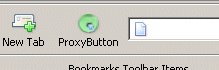
...but this here is quite sufficient: the ProxyButton extension.
Gives you a little button on the toolbar to switch from direct to proxy...
Read the FAQ style intro here once you installed it.
PS: if anyone feels the vpn-autodetect-thingy feels worthwhile (or has already been done), just leave a comment...
and it generally applies to every SW "issue".
Before sitting down and starting a project/hack, check if it does not yet exist.
This very instance of this insight has its origin in me no longer wanting to manually switch the FireFox proxy, whenever I switched from my home directy internet connectivity (wifi+dsl) to the company VPN, where I have to use a proxy.
Actually I wanted to do some little hack to automatically determine, if the VPN was on, and then magically using the company proxy...

...but this here is quite sufficient: the ProxyButton extension.
Gives you a little button on the toolbar to switch from direct to proxy...
Read the FAQ style intro here once you installed it.
PS: if anyone feels the vpn-autodetect-thingy feels worthwhile (or has already been done), just leave a comment...
Saturday, March 04, 2006
The wordprocessor has been replaced
Very interesting (and true) thought by Dan Bricklin on one of the recent Gillmor Gang podcasts:
Somewhere around 60'30, but as usual its worth listening to the whole show.
paper used to be the form we use to publish [...]
The wordprocessor - to most people - has been replaced by the e-mail product.
Somewhere around 60'30, but as usual its worth listening to the whole show.
Googlisms
Why doesn't Google Desktop also search in (Google) Picasa ???
Beats me.
But wouldn't it be nice, it the picasa tags/labels and the pictures' captions would also appear the (desktop) index?
Beats me.
But wouldn't it be nice, it the picasa tags/labels and the pictures' captions would also appear the (desktop) index?
Thursday, March 02, 2006
Sunday, February 26, 2006
Thunderbird Fcc extension
Finally I found a Thunderbird extension that allows me to select the Fcc folder on the compose/reply panel.
Not only can you control which folder the mail (once sent) should be filed into, but also
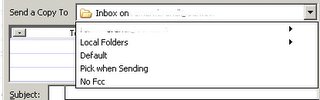
The latter option simply shows that whoever wrote this extension, knows what (s)he is doing. This is just awesome.
Not only can you control which folder the mail (once sent) should be filed into, but also
- not to save it at all (no fcc)
- on a reply to also move the original email to the same folder
The latter option simply shows that whoever wrote this extension, knows what (s)he is doing. This is just awesome.
Wednesday, February 22, 2006
SOA vs The Architects
With SOA and/or the concept of composite applications we will see an increase in ready-to-use business-services as well as technical-services.
This is the promise of SOA and a pre-requisite for composite applications.
What makes me wonder is, who will control access to those ready-to-use services? Just the term ready-to-use makes me panic.
And I don't mean just security wise? But rather from a logical level ?
Let's say I'm a developer and working on a composite application, or just in need of a service, that others already did and were friendly enough to provide to the whole enterprise.
Let's say - as in almost all examples - a credit check.
Let's say this is some in-house customer-service task I'm automating that from time-to-time needs to check the credit of a customer or prospect, e.g. 100 times a day.
With the help of the service registry I will be able to discover the credit check service and use it from my application (think UDDI/WSDL if that helps, but those are just protocols and formats to facilitate that).
So I'm happy, I found the service and I'm going to use that service.
There will probably some security restrictions as to which user is allowed to connect to the credit check. Good.
So I contact the supplier/owner of said service, tell him why and how I need access to it, and I will be granted access.
I finish my development/testing/whatever task and deploy my application to production. Everything runs smoothly, everybody is happy.
Half a year later, I'm working on a different application, and again need the credit check. I again look to the service registry, find the credit check service I'm famliar with (or I just remember it), and start using it for the new application.
This time, however, I'm working on a web application that issues quotes to prospective customers, and I have to include a credit check for the final calculation of the quote. The estimated number of quotes is several thousands a day (because I'm just a bit smaller then Amazon but still huge... ok).
Who will tell me, that using the (same) credit check service is still OK for me? Where can I find which load the credit check service is able to absorb? And at which load it is already running? There might be already 10 applications that use the credit check that comprise 90% of the whole capacity it was designed for, and now I'm adding another 70%? Who will keep me from doing so ?
Who will be able to do impact analysis on all the other 10 applications?
The only person/organisation that comes to mind is either the enterprise architects or some newly established integration architects/specialist.
But those guys need to have a more operational role than in the past. They need to know the general state of their services quite will. For the past, today and the months to come.
Isn't this a major shift in expectations from those groups?
Are they ready? Are the operatoin departments ready to let others, i.e. architects, etc, look into their system on a level usually reserverd to operators & andministrators ?
This is the promise of SOA and a pre-requisite for composite applications.
What makes me wonder is, who will control access to those ready-to-use services? Just the term ready-to-use makes me panic.
And I don't mean just security wise? But rather from a logical level ?
Let's say I'm a developer and working on a composite application, or just in need of a service, that others already did and were friendly enough to provide to the whole enterprise.
Let's say - as in almost all examples - a credit check.
Let's say this is some in-house customer-service task I'm automating that from time-to-time needs to check the credit of a customer or prospect, e.g. 100 times a day.
With the help of the service registry I will be able to discover the credit check service and use it from my application (think UDDI/WSDL if that helps, but those are just protocols and formats to facilitate that).
So I'm happy, I found the service and I'm going to use that service.
There will probably some security restrictions as to which user is allowed to connect to the credit check. Good.
So I contact the supplier/owner of said service, tell him why and how I need access to it, and I will be granted access.
I finish my development/testing/whatever task and deploy my application to production. Everything runs smoothly, everybody is happy.
Half a year later, I'm working on a different application, and again need the credit check. I again look to the service registry, find the credit check service I'm famliar with (or I just remember it), and start using it for the new application.
This time, however, I'm working on a web application that issues quotes to prospective customers, and I have to include a credit check for the final calculation of the quote. The estimated number of quotes is several thousands a day (because I'm just a bit smaller then Amazon but still huge... ok).
Who will tell me, that using the (same) credit check service is still OK for me? Where can I find which load the credit check service is able to absorb? And at which load it is already running? There might be already 10 applications that use the credit check that comprise 90% of the whole capacity it was designed for, and now I'm adding another 70%? Who will keep me from doing so ?
Who will be able to do impact analysis on all the other 10 applications?
The only person/organisation that comes to mind is either the enterprise architects or some newly established integration architects/specialist.
But those guys need to have a more operational role than in the past. They need to know the general state of their services quite will. For the past, today and the months to come.
Isn't this a major shift in expectations from those groups?
Are they ready? Are the operatoin departments ready to let others, i.e. architects, etc, look into their system on a level usually reserverd to operators & andministrators ?
Saturday, February 18, 2006
wikiCalc
wikiCalc (by softwaregarden) is a cool AJAX application that combines the "public" or rather collaborative editing approach of a wiki with the more traditional way of (structured?) data entry in a spread-sheet like this one here.
I've only tried this out myself (i.e. alone), but I have this feeling that this might really help in collaborative calc-like effort, e.g. when a group of people work on a business case or some other calculation with more than just one input.
I've only tried this out myself (i.e. alone), but I have this feeling that this might really help in collaborative calc-like effort, e.g. when a group of people work on a business case or some other calculation with more than just one input.
Friday, February 17, 2006
AJAX again
well since everyone talks about AJAX all the time, I might as well do so, too.
Here's a good resource (hub) for it: ajaxian
Here's a good resource (hub) for it: ajaxian
Tuesday, February 14, 2006
Loosely coupled monitoring
In the world of SOA, webservices and (generally) loosely coupling systems and applications, monitoring gets a new quality. And I really mean not just "more important" but a new quality.
I still can't say what it will have to look like, but the current (system/server centric) approach, with monitoring more or less single system (from a building block perspective) performance, availability, capacity, etc, etc will not be able to cover SOA et al.
I guess it will become more important to measure and know where a certain instance or class of message (or document) is using what kind of resources (or blocking them).
Won't monitoring "probes" become actual attributes or tags of the messages that traverse through the various buses and systems, being updated at each (logical) hop and at the same time updating some performance counters on those hops?
To me this looks like really orthogonal to today's approach.
I still can't say what it will have to look like, but the current (system/server centric) approach, with monitoring more or less single system (from a building block perspective) performance, availability, capacity, etc, etc will not be able to cover SOA et al.
I guess it will become more important to measure and know where a certain instance or class of message (or document) is using what kind of resources (or blocking them).
Won't monitoring "probes" become actual attributes or tags of the messages that traverse through the various buses and systems, being updated at each (logical) hop and at the same time updating some performance counters on those hops?
To me this looks like really orthogonal to today's approach.
Sunday, February 12, 2006
Tim Bray on Java vs LAMP
First of all, I don't think there is a real "vs." there, but anyway, its a catchy title.
Look here at what Tim actually has to say on this, I really love it.
Look here at what Tim actually has to say on this, I really love it.
Friday, February 10, 2006
Is there a fair price for software?
In a recent discussion a customer (or rather: a prospect) said that a certain price for a given piece of software was to high for him, because he would not "utilize everything the software can do".
Aha.
This again made me think of the metrics we nowadays use for licensing software:
(At this time I should disclose that I do work for Sun Microsystems.)
Yet another model, but this time not a technical one, but a purely commercial.
One advantage is that in general larger companies tend to pay more (more # of employees) and smaller companies pay less.
Another advantage is that you separate architecture decisions from commercial decisions.
Need a an additional node/cpu for your appserver? Go ahead, install it, use it. Whithout having to think about license implications.
That's what counts for me: get the commercial/administrative part out of the technical/architectural discussions and decisions.
In a way Oracle did the same, although they (usually) charge per CPU (or users...). Still a better model then charging per table or per tablespace, or - even worse - per transaction... (Guess everyone would turn of autocommit, then...)
Also, if you pay per CPU this at least some indicator on the performance and therefore value... not perfect, but still.
So why are we discussing this at all?
It's not only because of open-source and "free" software.
IMHO "free" software could only come to life because there was a debate about software pricing in the beginning.
Software does not deliver any tangible good - as opposed to servers or PCs or dish-washers.
With software you don't see and cannot touch what you are paying for.
That's why earlier software publishers seemed to define the value of the software by the amount of (printed) documentation they shipped with it.
Remember those huge software boxes that contained like 3-10 floppy disks and 3 tons of documentation? More docs, more money.
Now with software being downloaded from the internet, or delivered in packages only marginally larger then the CD/DVD case, this indicator vanished. Thank god.
But you still get the famous "software does not cost anything apart from the CD" every now and then.
Or the equally common "I could write this in 5 days, so why are you charging 100kUSD for this?"
There seem to be 2 schools of thought.
Redhat, Solaris, and all others that charge (directly or indirectly) for support fall into the first category.
Oralce, BEA, and even the Sun Java ES model fall into the second one... since their effort doesn't change with your number of CPUs (or employees), but (in a way) your value does.
Which is better? I don't know...
Which is more fair? Don't know either...
Which will prevail? Beats me, but we see a trend towards cost-based in the recent years, don't we.
And we're not even touching the software as a service discussion here...
Aha.
This again made me think of the metrics we nowadays use for licensing software:
- # of CPUs (or cores, or sockets, whatever)
- # of nodes
- # of instances
- # of users (and derivatives like # of mailboxes, ...)
- GB, TB, ...
(At this time I should disclose that I do work for Sun Microsystems.)
Yet another model, but this time not a technical one, but a purely commercial.
One advantage is that in general larger companies tend to pay more (more # of employees) and smaller companies pay less.
Another advantage is that you separate architecture decisions from commercial decisions.
Need a an additional node/cpu for your appserver? Go ahead, install it, use it. Whithout having to think about license implications.
That's what counts for me: get the commercial/administrative part out of the technical/architectural discussions and decisions.
In a way Oracle did the same, although they (usually) charge per CPU (or users...). Still a better model then charging per table or per tablespace, or - even worse - per transaction... (Guess everyone would turn of autocommit, then...)
Also, if you pay per CPU this at least some indicator on the performance and therefore value... not perfect, but still.
So why are we discussing this at all?
It's not only because of open-source and "free" software.
IMHO "free" software could only come to life because there was a debate about software pricing in the beginning.
Software does not deliver any tangible good - as opposed to servers or PCs or dish-washers.
With software you don't see and cannot touch what you are paying for.
That's why earlier software publishers seemed to define the value of the software by the amount of (printed) documentation they shipped with it.
Remember those huge software boxes that contained like 3-10 floppy disks and 3 tons of documentation? More docs, more money.
Now with software being downloaded from the internet, or delivered in packages only marginally larger then the CD/DVD case, this indicator vanished. Thank god.
But you still get the famous "software does not cost anything apart from the CD" every now and then.
Or the equally common "I could write this in 5 days, so why are you charging 100kUSD for this?"
There seem to be 2 schools of thought.
- cost-based,
i.e. charge based on the effort to write and support the software - value-based,
i.e. charge based on the (perceived) value the software brings to the customer/user
Redhat, Solaris, and all others that charge (directly or indirectly) for support fall into the first category.
Oralce, BEA, and even the Sun Java ES model fall into the second one... since their effort doesn't change with your number of CPUs (or employees), but (in a way) your value does.
Which is better? I don't know...
Which is more fair? Don't know either...
Which will prevail? Beats me, but we see a trend towards cost-based in the recent years, don't we.
And we're not even touching the software as a service discussion here...
Subscribe to:
Posts (Atom)
 Subscribe